
 EN
EN CN
CN
News
Global Sweetener Market Trends: Natural Sweeteners Are Poised For A Rise
Over the past decade, the global sweetener industry has undergone a major transformation. In the early years, the market was largely dominated by artificial sweeteners such as Aspartame, Acesulfame Potassium, and Sucralose due to their strong sweetness intensity, formulation stability, and cost advantages. However, consumer preferences are changing rapidly.Driven by the global trends of “clean… Continue reading Global Sweetener Market Trends: Natural Sweeteners Are Poised For A Rise
 August 18, 2026
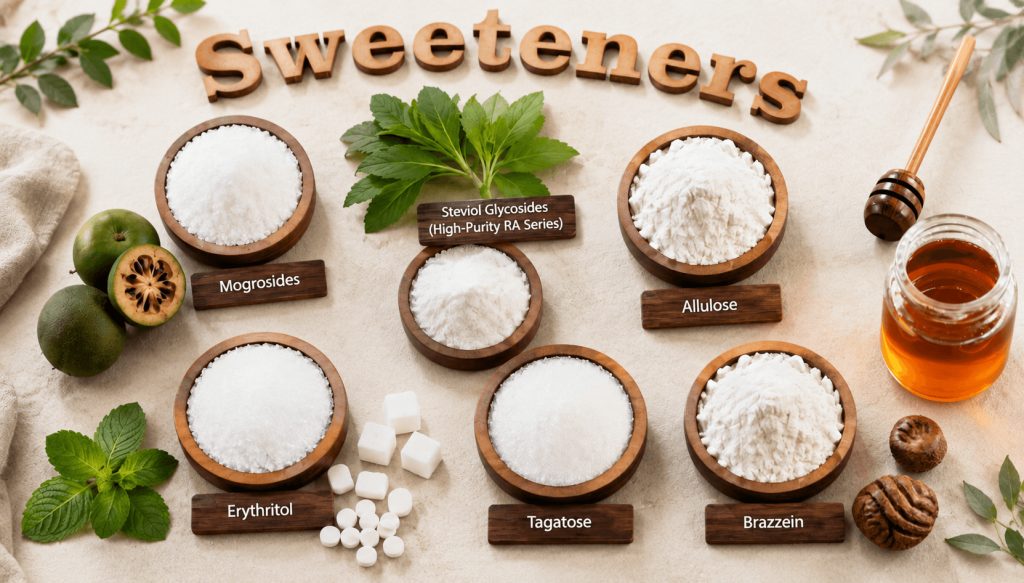
Over the past decade, the global sweetener industry has undergone a major transformation. In the early years, the market was largely dominated by artificial sweeteners such as Aspartame, Acesulfame Potassium, and Sucralose due to their strong sweetness intensity, formulation stability, and cost advantages.
However, consumer preferences are changing rapidly.Driven by the global trends of “clean label,” “plant-based,” “sugar reduction,” and “better-for-you nutrition,” natural sweeteners are now becoming the core direction for new product development across beverages, functional foods, dietary supplements, dairy products, confectionery, and nutraceuticals.
Today, major international brands are actively reformulating products to reduce sugar content while maintaining a sugar-like taste experience. As a result, ingredients such as Allulose, Monk Fruit Extract, and high-purity Steviol Glycosides are experiencing explosive growth in North America, Europe, and Asia-Pacific markets.
Fastest Growing Natural Sweeteners
Natural sweeteners are expected to continue outperforming synthetic sweeteners in premium food and beverage applications. The biggest drivers are regulatory acceptance, consumer trust, and improved taste technology.
1. Allulose — The Fastest Growing Rare Sugar
Source: Fructose isomerization
Applications: Beverages, ice cream, dairy, nutrition products
Allulose has become one of the hottest sweeteners in the United States market. It delivers a taste profile very close to sucrose, with extremely low calories and good FDA positioning for reduced-sugar labeling.
Compared with traditional polyols, Allulose provides:
- Better mouthfeel
- Lower cooling effect
- Excellent beverage performance
- Sugar-like browning in bakery systems
Large beverage companies are increasingly using Allulose in zero-sugar and functional drink formulations.
2. Monk Fruit Extract — Clean Label Star Ingredient
Main Component: Mogroside V 25%–60%
Applications: Functional beverages, syrups, supplements
Monk Fruit is rapidly expanding in both North America and Europe due to its strong clean-label positioning.
Unlike artificial sweeteners, Monk Fruit is perceived as:
- Plant-based
- Natural
- Consumer-friendly
- Suitable for premium wellness products
Many brands combine Monk Fruit (Luohanguo) with Erythritol or Stevia to improve sweetness balance and reduce aftertaste.
3. Steviol Glycosides — Still the Global Mainstream
Applications: Beverages, sports nutrition, gummies, tablets
Stevia remains one of the most widely used natural sweeteners globally. However, the market is shifting from traditional RA60/RA80 grades toward high-purity Reb M and Reb D systems.
Why Reb M Is Growing Fast
Reb M offers:
- Cleaner sweetness
- Reduced bitterness
- Taste closer to sugar
- Better compatibility with modern beverage systems
As fermentation technology improves, Reb M production costs are expected to decrease significantly over the next several years.
4. Erythritol — Core Bulk Sweetener
Applications: Sugar-free candy, tablets, beverages, bakery
Erythritol remains one of the most important bulk sweeteners in sugar-free systems because it provides:
- Very low calories
- Excellent digestive tolerance
- Good stability
- Synergy with high-intensity sweeteners
Although market competition has intensified, Erythritol is still a foundational ingredient in most sugar-reduction formulations.
5. Tagatose — Emerging Low-GI Opportunity
Applications: Dairy, chocolate, bakery
Tagatose is gaining attention because of its:
- Low glycemic index
- Sugar-like taste
- Heat stability
- Good digestive profile
It is increasingly used in premium diabetic-friendly and metabolic health products.
Other Important Natural Sweeteners
Several other sweetening ingredients continue to play important roles in formulation systems:
| Ingredient | CAS | Main Applications |
| Xylitol | 87-99-0 | Gum, toothpaste, candies |
| Maltitol | 585-88-6 | Chocolate, confectionery |
| Sorbitol | 50-70-4 | Syrups, humectants |
| Isomalt | 64519-82-0 | Hard candy |
| Trehalose | 6138-23-4 | Bakery, frozen foods |
| Inulin | 9005-80-5 | Prebiotic sweetening systems |
| Fructooligosaccharides | 308066-66-2 | Dairy, beverages |
Artificial Sweeteners Still Hold Strong Market Advantages
Despite the rapid growth of natural sweeteners, artificial sweeteners still maintain strong market share because of:
Low formulation cost
High sweetness intensity
Excellent heat stability
Mature global supply chains
The most widely used synthetic sweeteners:
| Ingredient | CAS | Main Applications |
| Sucralose | 56038-13-2 | Beverages, bakery |
| Aspartame | 22839-47-0 | Soft drinks |
| Acesulfame Potassium | 55589-62-3 | Sweetener blends |
| Saccharin Sodium | 6155-57-3 | Beverages, pickles |
| Sodium Cyclamate | 139-05-9 | Tabletop sweeteners |
| Neotame | 165450-17-9 | High-intensity sweetening |
| Advantame | 714229-20-6 | Ultra-high sweetness systems |
| NHDC | 20702-77-6 | Bitter masking |
In many cost-sensitive beverage applications, blends of Sucralose + Ace-K remain highly competitive.
Future Development Trends and Opportunities of Sweeteners
Sweeteners Market Growth Drivers
Changing Consumer Behavior Toward Health and Wellness: Recently, consumer behavior toward health and wellness has fundamentally changed. Consumers are aware of the impact of sugar consumption on their health, such as obesity, diabetes, and heart conditions. Hence, there is an increased demand for alternatives that are sweet and without calories, thereby enhancing the demand for low-calorie and zero-calorie sweeteners in the market.
The Desire for Health-Conscious Products: The consumer now wants a product that allows them to enjoy their sweet tooth without compromising on a healthy lifestyle. These factors influence the manufacturers in the food and beverage industries, where manufacturers are reformulating their products to make room for natural sweeteners, such as stevia and monk fruit.
Advancements in Food Technologies: Food technologies are now the driving force for development in the sweetener market.Developments in extraction techniques, fermentation technologies, and synthetic biology have resulted in the development of new low-calorie sweeteners that are far more efficient and cost- effective to produce.
Sweeteners Market Future Trends
Increasing Trend Towards Natural Sweeteners: There is an increasing trend toward adopting natural sweeteners simply because consumers increasingly demand clean and organic products. Consumers are interested in natural sweeteners, including stevia and monk fruit, which are perceived to be healthier and less processed. Also, numerous health risks and adverse effects are associated with artificial sweeteners.
Market Investment in Research and Development: The key players in the market are investing in research and development to incorporate these alternatives. Also, the increasing demand for organic certifications and non-GMO labels helps to this trend and forces manufacturers to formulate product to meet consumers expectations.
Innovation and Application in the Food and Beverage Industry: Innovation in sweeteners increases the application of the food and beverages industry. Changing consumer preferences leads manufacturers to find new ways to add sweeteners to their products. From ready-to-drink beverages to snacks and baked products, the flavor profile must be enhanced while meeting health standards.
Sweeteners Market Opportunities
Consumer Engagement Through Personalization: Increasing demand for personalized products and the drive to have products that cater to particular health needs and preferences further create new opportunities in the sweetener market. Technological advances, including wearable devices and mobile health applications, enable people to monitor their dietary habits and make healthier choices. They also allow for the personalization of sweetener formulations to accommodate particular diets.
Technological Advances Supporting Health Choices: For instance, keto-friendly sweeteners formulated for low-carb diets or sweeteners enriched with functional ingredients intended to offer specific health benefits to consumers. The companies also offer personalization options, letting customers choose their preferred sweetness level or different blends of sweeteners.
Future Growth and Innovation in the Sweetener Industry: Embracing personalized nutrition will then offer sweetener firms the possibility of exploiting a rapidly expanding consumer market that focuses on individualization and health optimization and, therefore, on growth and innovation in the industry.
Application Analysis and Market Segmentation
- Beverages The beverage segment is the largest and most influential application for sweeteners, projected to grow at an annual rate of 3.5%-9.0%. This sector is the primary battleground for sugar reduction, with carbonated soft drinks, sports drinks, and functional teas leading the transition to high-intensity sweeteners. Manufacturers are increasingly utilizing “sweetener stacks” – blending multiple types like sucralose and acesulfame potassium – to achieve a more rounded, sugar-like flavor profile while meeting tightening regulatory standards on calorie content.
- Bakery & Confectionery The bakery and confectionery segment is expected to expand at 2.5%-7.5% annually. In these applications, sweeteners serve dual purposes: providing flavor and acting as functional agents for texture, browning (Maillard reaction), and shelf-life extension. Low-calorie bulk sweeteners like erythritol and xylitol are gaining significant traction here because they provide the physical volume necessary for baking without the caloric density of sucrose. In the confectionery space, sugar-free gums and candies continue to be high-margin growth drivers.
- Dairy & Frozen Desserts The dairy segment is witnessing a steady growth rate of 3.0%-8.0% per year. The rise of Greek yogurts and plant-based milk alternatives has necessitated the use of sweeteners that can balance acidity and complement creamy textures. Innovative “rare sugars” like allulose are becoming popular in frozen desserts because they do not crystallization like traditional sugar, maintaining the smooth texture consumers expect in ice creams.
- Pharmaceuticals In the pharmaceutical sector, sweeteners are utilized to mask the bitter taste of active ingredients in pediatric liquids, chewable tablets, and cough syrups. This segment is projected to grow by 2.0%-6.5% annually. The choice of sweetener here is highly regulated, with a preference for non-cariogenic (tooth-friendly) polyols that do not impact glycemic levels, making them safe for diabetic patients.
Form Analysis and Market Segmentation
- Solid Form Solid sweeteners, including granulated powders and crystals, dominate the market with a projected annual growth of 2.0%-7.0%. They are the primary format for industrial baking, tabletop usage, and dry beverage mixes. The focus in this segment is on “flowability” and particle size consistency to ensure even distribution during large-scale manufacturing.
- Liquid Form Liquid sweeteners are expected to grow at a faster rate of 4.5%-10.0% annually. This growth is driven by their ease of integration into continuous beverage production lines and the rising popularity of liquid natural sweeteners like agave syrup and liquid stevia drops for the “on-the-go” consumer segment.
Sweetener Market Segmentation
- Sweeteners Market Type Outlook
Natural Sweeteners
Artificial Sweeteners
Sugar Alcohols
Steviol Glycosides
Agave Syrup
Mixed Sweeteners
- Sweeteners Market End Use Outlook
Food Industry
Beverage Industry
Pharmaceuticals
Personal Care
Functional Nutrition
- Sweeteners Market Application Outlook
Beverages
Bakery
Confectionery
Dairy Products
Sauces and Dressings
- Sweeteners Market Formulation Outlook
Liquid
Powder
Granular
Tabletop
Bulk
Regional Insights
North America : Market Leader in Sweeteners Market
North America is the largest market for sweeteners, holding approximately 40% of the global share. The region’s growth is driven by increasing health consciousness, demand for low-calorie products, and regulatory support for alternative sweeteners. The U.S. leads this market, followed closely by Canada, which contributes around 15% to the overall market. Regulatory frameworks favoring natural sweeteners further enhance market dynamics. The competitive landscape is characterized by major players such as Cargill, Archer Daniels Midland, and DuPont, which dominate the market with innovative product offerings. The presence of these key players fosters a robust supply chain and encourages research and development in sweetener alternatives. The U.S. market is also witnessing a rise in local manufacturers, enhancing competition and product diversity.
Europe : Regulatory Framework Drives Growth
Europe is the second-largest market for sweeteners, accounting for approximately 30% of the global market share. The region’s growth is propelled by stringent regulations promoting healthier food options and the increasing demand for sugar alternatives. Countries like Germany and France are at the forefront, with Germany holding about 12% of the market share, driven by consumer preferences for natural sweeteners and low-calorie products. The competitive landscape in Europe is marked by key players such as Tate & Lyle and Roquette Freres, which are actively innovating to meet consumer demands. The presence of regulatory bodies ensures compliance with food safety standards, fostering a competitive environment. Additionally, the European market is seeing a rise in local producers, enhancing the diversity of sweetener options available to consumers.
Asia-Pacific : Emerging Market Potential
Asia-Pacific is an emerging powerhouse in the sweeteners market, holding approximately 25% of the global share. The region’s growth is driven by rising disposable incomes, urbanization, and a shift towards healthier dietary choices. China and Japan are the leading countries, with China contributing around 15% to the market, fueled by increasing demand for low-calorie and natural sweeteners in food and beverage sectors. The competitive landscape is evolving, with key players like Ajinomoto and Mitsubishi Corporation leading the charge. The presence of these companies fosters innovation and product development tailored to local tastes. Additionally, the region is witnessing an influx of new entrants, enhancing competition and expanding the variety of sweeteners available to consumers, thus catering to diverse preferences and dietary needs.
Middle East and Africa : Untapped Market Opportunities
The Middle East and Africa represent a growing segment of the sweeteners market, accounting for approximately 5% of the global share. The region’s growth is driven by increasing health awareness and a shift towards sugar alternatives in response to rising obesity rates. Countries like South Africa and the UAE are leading this market, with South Africa holding about 3% of the market share, driven by consumer demand for healthier food options. The competitive landscape is characterized by a mix of local and international players, including Sweetener Supply Corporation. The presence of these companies is crucial for market development, as they introduce innovative sweetener solutions tailored to regional tastes. Additionally, the region’s regulatory environment is gradually evolving to support the growth of the sweeteners market, creating opportunities for expansion and investment.

Jady
Jady has over 20 years of experience in the plant extract industry and is a seasoned expert in natural plant active ingredients. She specializes in the research, analysis, and extraction of plant extracts, natural sweeteners, mushroom extracts, cosmetic ingredients, and other plant active ingredients. Jady possesses a deep understanding of international food safety standards such as FDA and EFSA, and can clearly explain complex biochemical concepts to formulators worldwide. Her expertise effectively helps brands bridge the gap between scientific research and commercial applications, focusing on developing natural health products. She excels at guiding brands to understand the specific applications of various ingredients in dietary supplements, functional foods, and cosmetics, enabling clients to more easily select suitable ingredients and find reliable solutions.


Get in Touch
If you are considering sourcing high-quality raw materials, developing new products, customizing formulas, or have any other questions, please contact us!
We are ready to provide you with high-quality raw materials, personalized formula customization, private label solutions, or any other assistance to help you embark on your brand journey!
